
SaaS Webhook Reliability: Signatures, Idempotency, and Retries That Survive Production
Build reliable SaaS webhooks: HMAC verification, fast 2xx acks, atomic idempotency, retries, and dead-letter queues that keep events from becoming incidents.
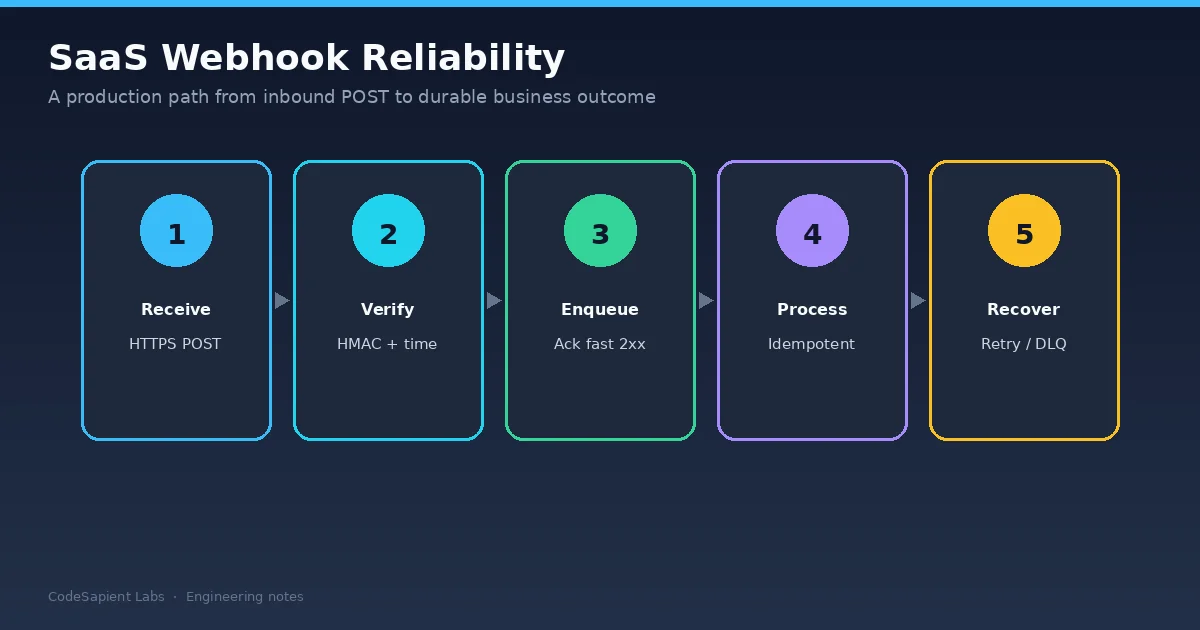
Most SaaS products look “integrated” the moment a partner can POST events to an HTTPS URL. Then production arrives: a payment provider retries after a timeout, a signature check fails because middleware re-serialized JSON, a duplicate invoice.paid creates two entitlements, and on-call spends the night reconciling state by hand. The HTTP endpoint was easy. Webhook reliability is the engineering discipline that keeps those events authentic, deduplicated, and recoverable when networks and workers misbehave.
This guide focuses on inbound webhooks for SaaS—payments, billing, CRM, shipping carriers, marketplace apps—and the patterns that turn at-least-once delivery into correct business outcomes. Soft product CTAs aside, the same checklist applies whether you build in Django, Laravel, Node, or Go. Teams that ship custom integrations through CodeSapient treat webhooks as a first-class subsystem, not a controller method bolted on late.
Why webhook reliability breaks in production
Providers almost never promise exactly-once delivery. They promise best-effort notifications with retries when your endpoint is slow, returns 5xx, or never responds. That creates four failure modes that show up together:
- Duplicates — the same event ID arrives twice after a timeout or reconnect.
- Reordering — a retry of an older event lands after a newer one.
- Poison requests — forged or replayed payloads if signatures are weak or skipped.
- Slow handlers — synchronous side effects exceed the provider’s ack window and amplify retries.
If you only “parse JSON and update the database,” you will eventually charge twice, unlock a feature twice, or miss an event that looked successful in the provider dashboard but never survived your app crash between write and ack.
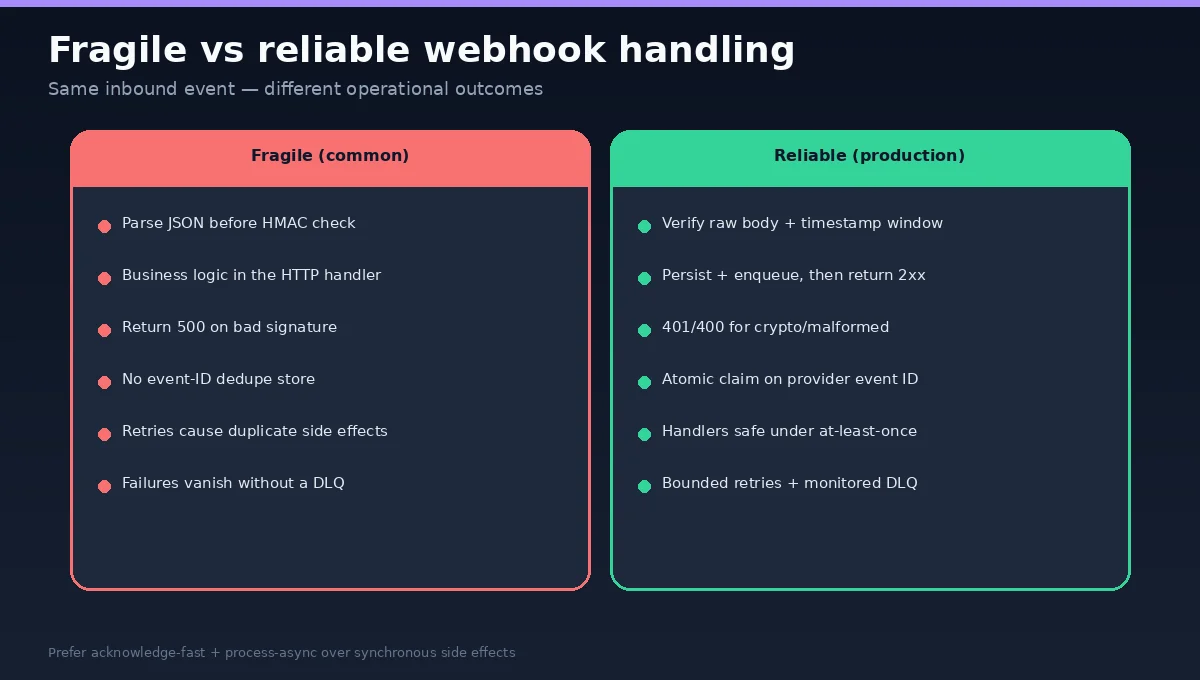
The production receive path
A durable inbound path is a short, ordered checklist:
- Terminate TLS on a public HTTPS endpoint (no plain HTTP in production).
- Capture the raw body before any JSON parser mutates bytes.
- Verify the HMAC signature (and timestamp window) with a constant-time compare.
- Persist the envelope (provider, event ID, type, raw payload, received_at) or claim an idempotency key.
- Enqueue async work and return 2xx quickly.
- Process in a worker with retries, observability, and a dead-letter path.
Stripe’s official guidance matches this shape: verify signatures, handle duplicates, process asynchronously, and return a 2xx before heavy work. See Stripe’s webhook docs and their signature verification notes. GitHub, Shopify Admin webhooks, and most payment/CRM vendors publish the same core rules with different header names.
Signature verification done correctly
Signature checks prove authenticity; they are not optional middleware candy.
Raw body, not re-serialized JSON
HMAC is computed over exact bytes. Frameworks that run a global JSON body parser before your webhook route often break verification because whitespace, key order, or encoding changed. Scope a raw-body parser to the webhook route only. Verify first; parse second.
Constant-time comparison and secrets
Compare digests with a constant-time function (hmac.compare_digest, crypto.timingSafeEqual). Never use == on hex strings for security-sensitive equality. Store endpoint secrets in a secret manager; rotate on a schedule and support dual secrets during rotation windows.
Replay windows
Many schemes sign timestamp + "." + body (Stripe’s Stripe-Signature pattern). Reject timestamps outside a small skew window (commonly about five minutes). That limits how long a captured request remains useful to an attacker. Return 401 (or a documented non-retryable client error) for bad signatures—do not return 5xx, or you invite infinite provider retries of garbage.
# Illustrative Python sketch (provider-specific details omitted)
import hmac, hashlib, time

def verify(raw_body: bytes, header: str, secret: str, max_age_sec: int = 300) -> bool:
    # Parse provider timestamp + signatures from header...
    timestamp, signatures = parse_header(header)
    if abs(time.time() - timestamp) > max_age_sec:
        return False
    expected = hmac.new(secret.encode(), f"{timestamp}.".encode() + raw_body, hashlib.sha256).hexdigest()
    return any(hmac.compare_digest(expected, sig) for sig in signatures)
Acknowledge fast, process asynchronously
Provider timeouts turn slow handlers into duplicate storms. The reliable pattern is:
- Validate signature and basic schema.
- Write a durable receipt (database row or outbox) and/or push to a queue.
- Respond
200/202within the provider’s window (often a few seconds). - Run fulfillment, entitlement grants, emails, and partner fan-out in workers.
That async boundary is the same reason SaaS apps use task queues for exports and emails—see our notes on Django Celery and Redis background jobs. Webhooks are simply another ingress that must not monopolize the request thread.
If your “webhook handler” also calls three partner APIs and generates a PDF, you do not have a webhook handler—you have a distributed transaction pretending to be HTTP.
Idempotency: turning at-least-once into safe outcomes
Dedup is not a boolean flag; it is an atomic claim on a stable event identity.
Choose the right key
- Prefer the provider event ID (for example Stripe
evt_...) as the primary idempotency key. - If the provider only gives a delivery ID, store that too—retries may mint new delivery IDs for the same logical event; know your vendor’s semantics.
- Keep a TTL or retention at least as long as the provider’s retry horizon (often hours to days).
Claim before side effects
Avoid check-then-act races under concurrent retries. Use an atomic insert:
-- Conceptual: claim the event, then process in the same unit of work
INSERT INTO webhook_events (provider, event_id, event_type, payload, status)
VALUES ($1, $2, $3, $4, 'processing')
ON CONFLICT (provider, event_id) DO NOTHING
RETURNING id;
If the insert returns no row, another worker already claimed it—return success without re-applying side effects. Apply business updates in the same transaction as flipping status to processed, or use a transactional outbox so “marked processed” and “side effect recorded” cannot diverge silently.
Make handlers themselves idempotent
Even with dedup tables, design domain operations as safe under replay: set entitlements to a desired state rather than incrementing counters blindly; use upserts; pass idempotency keys to downstream payment or email APIs when available.
Retries, backoff, and dead-letter queues
Distinguish provider retries to your endpoint from your worker retries after you already acked.
- Provider side: return 2xx only after durable accept. Return 4xx for permanent client problems (bad signature, malformed body). Return 5xx only when you want them to try again later.
- Worker side: retry transient failures with exponential backoff and jitter; cap attempts; classify poison messages.
- DLQ: after exhaustion, move the event to a dead-letter store with payload, last error, and a replay tool operators can run after a fix.
A DLQ without replay is just a fancy trash can. Alert on DLQ depth and age the same way you alert on payment failures.
Outbound webhooks (when you are the provider)
If your SaaS emits webhooks to customers, mirror the same contract you demand from vendors:
- Sign every delivery; document the header and algorithm.
- Include a stable event ID and timestamp.
- Retry with backoff on timeouts and 5xx; stop on most 4xx.
- Offer a delivery log UI and manual resend.
- Respect customer rate limits so one slow endpoint cannot stall your whole dispatcher.
Background workers and queues keep outbound fan-out off the request path—again aligning with task-queue architecture rather than synchronous loops in a web process.
Observability that makes incidents boring
Minimum signals for SaaS webhook reliability:
- Counters: received, verified, rejected (signature/replay), enqueued, processed, duplicate, DLQ.
- Latency: time-to-ack and time-to-process by event type.
- Structured logs with provider, event ID, delivery ID, and correlation ID—never log full secrets or card data.
- Traces spanning HTTP receive → queue → worker → downstream API.
When an enterprise customer says “we never got order.fulfilled,” you should answer from your delivery table in minutes, not from memory.
Common mistakes
- Verifying after JSON parse — HMAC fails intermittently; teams disable verification “temporarily.”
- Doing business work before 2xx — timeouts create duplicate storms.
- Returning 500 on bad signatures — trains providers to hammer you.
- Non-atomic dedupe — two workers both “see unused” and both fulfill.
- Ignoring out-of-order events — apply version checks or fetch current resource state from the provider API when order matters.
- No secret rotation story — a leaked endpoint secret becomes a forged-event machine.
- No DLQ / replay — permanent failures disappear into error trackers without recovery.
- One shared endpoint without per-tenant isolation — noisy neighbors and ambiguous auth boundaries in multi-tenant apps.
SaaS use cases that need this discipline
- Billing and entitlements — payment succeeded/failed events that unlock or revoke seats.
- Marketplace and app platforms — install/uninstall, GDPR request, and bulk operation callbacks (including Shopify app webhooks when you build custom apps—see custom Shopify app development with Functions).
- Document and AI pipelines — async job completion events that must not double-index content; related reading on grounded retrieval: RAG for internal knowledge bases.
- Partner sync — CRM, ERP, and WMS status changes that drive customer-visible SLAs.
Implementation checklist
- Document every inbound provider: headers, secret location, retry policy, event ID field.
- Implement raw-body signature verification with replay window and dual-secret rotation.
- Add a durable
webhook_events(or equivalent) table with a unique (provider, event_id) constraint. - Enqueue processing; ack 2xx only after durable accept.
- Build idempotent domain handlers; add worker retries + DLQ with replay.
- Dashboards and alerts on reject rate, duplicates, processing lag, and DLQ depth.
- Contract tests with provider CLI/fixtures (for example Stripe CLI forwarding) in CI.
- Run a game-day: force timeouts, duplicates, and bad signatures before launch.
FAQ
Are webhooks reliable enough for money movement?
Webhooks are notifications, not the source of truth. For payments, verify signatures, process idempotently, and reconcile against the provider’s API or reports. Never grant irreversible value solely because an unverified POST arrived.
Should I IP-allowlist providers?
Allowlists can be a defense-in-depth layer when the vendor publishes stable ranges, but they churn and are easy to misconfigure. Treat HMAC verification as mandatory; treat IP allowlists as optional hardening.
Is a queue mandatory?
For low volume you can persist-and-ack in the request and process via a lightweight async runtime—but you still need durable storage, idempotency, and retries. At real SaaS volume, an explicit queue (or at least a transactional outbox polled by workers) is the safer default.
Conclusion
Webhook reliability is not a library choice; it is a contract: verify authenticity, ack quickly, claim each event once, and recover failures with backoff and a dead-letter path. Teams that invest here spend less time in reconciliation spreadsheets and more time shipping product.
If you are hardening inbound or outbound webhooks as part of a custom SaaS or marketplace integration, contact CodeSapient. Explore custom software services or more engineering writing on the blog.